Philippe Boisnard
Online Projects
- ADN-MOVIE Software for performing film analysis with advanced AI tools. (2015-2026)
- Latent Flora — Structural Unconscious 1,100 AI-generated flowers, SAM segmentation, UMAP latent space walk (2023-2025)
- Latent Art History — Computational Hermeneutics 1,000 artworks analyzed through CLIP semantic axes and SAM segmentation (2026)
- Art Explorer — Visual Search Zone of Attention - AN INTROSPECTION INTO THE SCOPIC REGIMES OF CLIP VIT-B/16 (2026)
- Temporal Sedimentation Benchmark Interactive CLIP tool for visual temporal exploration (2026)
- Ce qui écrit avant l'auteur, Complétion algorithmique et conditions computationnelles de l'énonçable. Un benchmark différentiel sur six modèles de langage open-weights. (2026)
Writings on AI & Art
- The Algorithmic Unconscious: Structural Mechanisms and Implicit Biases in Large Language Models Extended version of a paper presented at the international conference 'Artificial Intelligence and Transformations of Information' (LOGOS/FLSH, Hassan II University of Casablanca, Morocco, December 2025 — This article introduces the concept of the algorithmic unconscious to designate the set of structural determinations that operate within large language models (LLMs) without being accessible either to the model's own reflexivity or to that of its users. In contrast to approaches that reduce AI bias solely to dataset composition or to the projection of human intentionality, we argue that a significant class of biases emerges directly from the technical mechanisms of the models themselves: tokenization, attention, statistical optimization, and alignment procedures. By framing bias as an infrastructural phenomenon, this approach resolves a central theoretical ambiguity surrounding responsibility, neutrality, and correction in contemporary LLMs. Based on a comparative analysis of tokenization across a corpus of parallel sentences, we show that Arabic languages (Modern Standard Arabic and Maghrebi dialects) undergo a systematic inflation in token count relative to English, with ratios ranging from 1.6x to nearly 4x depending on the infrastructure (OpenAI, Anthropic, SentencePiece/Mistral). This over-segmentation constitutes a measurable infrastructural bias that mechanically increases inference costs, constrains access to contextual space, and alters attentional weighting within model representations. We relate these empirical findings to three additional structural mechanisms: causal bias (correlation vs causation), the erasure of minoritized features through dimensional collapse, and normative biases induced by safety alignment. Finally, we propose a framework for a technical clinic of models, grounded in the audit of tokenization regimes, latent space topology, and alignment systems, as a necessary condition for the critical appropriation of AI infrastructures.
- From Metrology to Hermeneutics: Beyond Manovich 2026 — CLIP as a tool for computational art criticism
- Ethology of Latent Spaces Hyperheritage International Symposium 9 — SThis study challenges the presumed neutrality of latent spaces in vision language models (VLMs) by adopting an ethological perspective on their algorithmic behaviors. Rather than constituting spaces of homogeneous indeterminacy, latent spaces exhibit model-specific algorithmic sensitivities, understood as differential regimes of perceptual salience shaped by training data and architectural choices. Through a comparative analysis of three models (OpenAI CLIP, OpenCLIP LAION, SigLIP) applied to a corpus of 301 artworks (15th to 20th), we reveal substantial divergences in the attribution of political and cultural categories. Using bipolar semantic axes derived from vector analogies (Mikolov et al., 2013), we show that SigLIP classifies 59.4% of the artworks as politically engaged, compared to only 4% for OpenCLIP. African masks receive the highest political scores in SigLIP while remaining apolitical in OpenAI CLIP. On an aesthetic colonial axis, inter-model discrepancies reach 72.6 percentage points. We introduce three operational concepts: computational latent politicization, describing the emergence of political categories without intentional encoding; emergent bias, irreducible to statistical or normative bias and detectable only through contrastive analysis; and three algorithmic scopic regimes: entropic (LAION), institutional (OpenAI), and semiotic (SigLIP), which structure distinct modes of visibility. Drawing on Foucault's notion of the archive, Jameson's ideologeme, and Simondon's theory of individuation, we argue that training datasets function as quasi-archives whose discursive formations crystallize within latent space. This work contributes to a critical reassessment of the conditions under which VLMs are applied to digital art history and calls for methodologies that integrate learning architectures into any delegation of cultural interpretation to algorithmic agents.
- Prolegomena to a Post-Aesthetics of Artificial Imaginations 2024 — The acceleration of the use of generative artificial intelligences (AI), since 2015 and the turning point operated by Deepdream, tends to obscure a real analysis of what could be defined as artificial imagination. AIs are either reduced to simple instruments or thought of according to a form of techno-theologism. Our research tends to suspend any form of judgment in order to phenomenally grasp the emergence of these AIs. By taking up the question of Hegel's aesthetics and of art as the free production of the mind, but by moving it towards the question of generative AIs and therefore of a post-aesthetics, this article will show the phenomenal specificity of images generated by AI.
Œuvres (2008–2024)
-
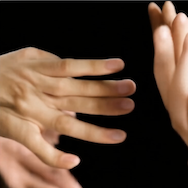 Its hands
2024 — [AI / Video] Without prompt, the AI mutates in loop the latent possibilities of a hand-model it produced itself.
Its hands
2024 — [AI / Video] Without prompt, the AI mutates in loop the latent possibilities of a hand-model it produced itself.
-
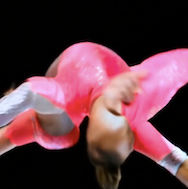 Latent Boody
2024 — [AI / Video] The body mutating through the algorithmic sensitivity of latent space.
Latent Boody
2024 — [AI / Video] The body mutating through the algorithmic sensitivity of latent space.
-
 In the middle of latent space
2024 — [AI / Video] From images of Gaza, an unstable arid universe punctures the mass of war images.
In the middle of latent space
2024 — [AI / Video] From images of Gaza, an unstable arid universe punctures the mass of war images.
-
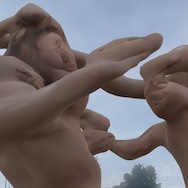 Dance Around the World
2024 — [AI + AR] Participatory work: AI sculptors of dancers performing across the world.
Dance Around the World
2024 — [AI + AR] Participatory work: AI sculptors of dancers performing across the world.
-
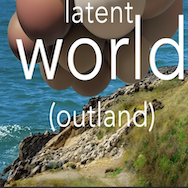 Latent World (OutLand)
2024 — [iOS / AI + AR] Discover AI-generated animated 3D works around the world in AR.
Latent World (OutLand)
2024 — [iOS / AI + AR] Discover AI-generated animated 3D works around the world in AR.
-
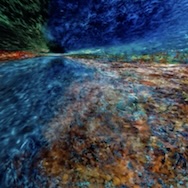 Completion: latent space of off-screen
2024 — [AI / Video] The AI imagines the off-camera of Hopper's pictures with an out-zoom.
Completion: latent space of off-screen
2024 — [AI / Video] The AI imagines the off-camera of Hopper's pictures with an out-zoom.
-
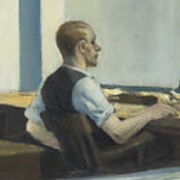 Completion: No off-screen events
2024 — [AI / Photo] An AI without prompt imagines the off-camera of Hopper's paintings.
Completion: No off-screen events
2024 — [AI / Photo] An AI without prompt imagines the off-camera of Hopper's paintings.
-
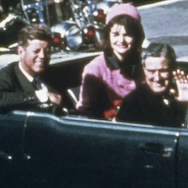 Completion
2024 — [AI / Photo] Digital photography: the AI imagines what lies off-camera, without prompt.
Completion
2024 — [AI / Photo] Digital photography: the AI imagines what lies off-camera, without prompt.
-
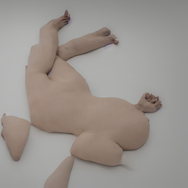 Archéologie d'une mémoire impossible
2024 — [AI / Model] By training a latent space model, the AI generates non-predictable bodies.
Archéologie d'une mémoire impossible
2024 — [AI / Model] By training a latent space model, the AI generates non-predictable bodies.
-
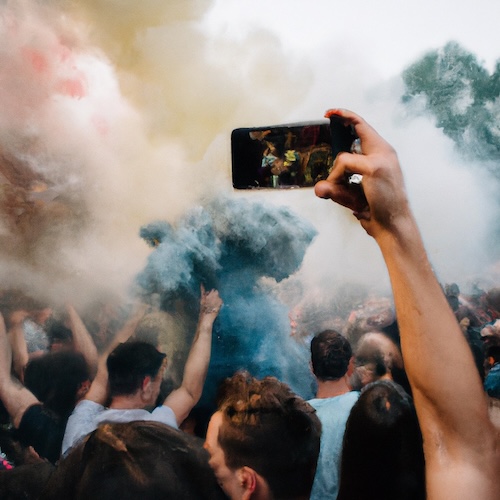 The Happening
2022 — [AI / Photo] Digital photography created with artificial intelligence.
The Happening
2022 — [AI / Photo] Digital photography created with artificial intelligence.
-
_11.jpg) Our Wealth — notre richesse
2022 — [AI / Photo] Digital photography created with artificial intelligence.
Our Wealth — notre richesse
2022 — [AI / Photo] Digital photography created with artificial intelligence.
-
 Single Machine — machine célibataire
2022 — [AI / Photo] Digital photography created with artificial intelligence.
Single Machine — machine célibataire
2022 — [AI / Photo] Digital photography created with artificial intelligence.
-
 No Time for Movie
2021 — [AI / Video] An investigation into the pseudo-time of AI-generated video.
No Time for Movie
2021 — [AI / Video] An investigation into the pseudo-time of AI-generated video.
-
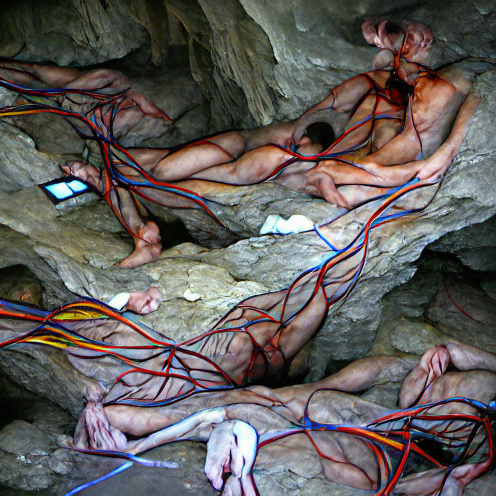 The rest of our humanity: disaster landscape 5
2021 — [AI / Photo] Digital photography created with artificial intelligence.
The rest of our humanity: disaster landscape 5
2021 — [AI / Photo] Digital photography created with artificial intelligence.
-
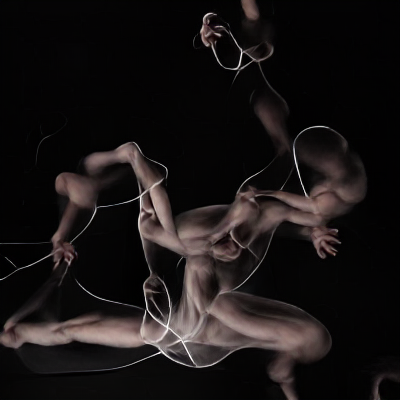 Body Mutation: the absent body
2021 — [AI / Photo] Digital photography created with artificial intelligence.
Body Mutation: the absent body
2021 — [AI / Photo] Digital photography created with artificial intelligence.
-
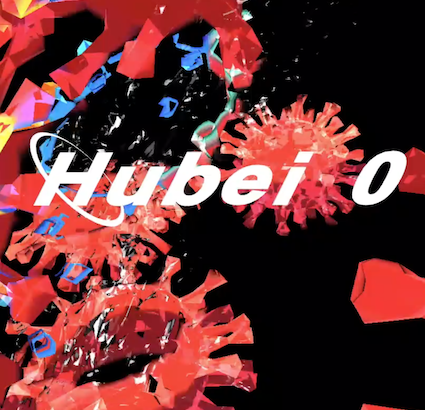 After COVID_19 (paysage de la catastrophe 3)
2020 — Live audio/visual: post-human landscape unfolding from the COVID-19 epidemic.
After COVID_19 (paysage de la catastrophe 3)
2020 — Live audio/visual: post-human landscape unfolding from the COVID-19 epidemic.
-
 Paysage de la catastrophe (After Fukushima 2)
2018–2020 — Second, participatory version of the catastrophe landscape installation.
Paysage de la catastrophe (After Fukushima 2)
2018–2020 — Second, participatory version of the catastrophe landscape installation.
-
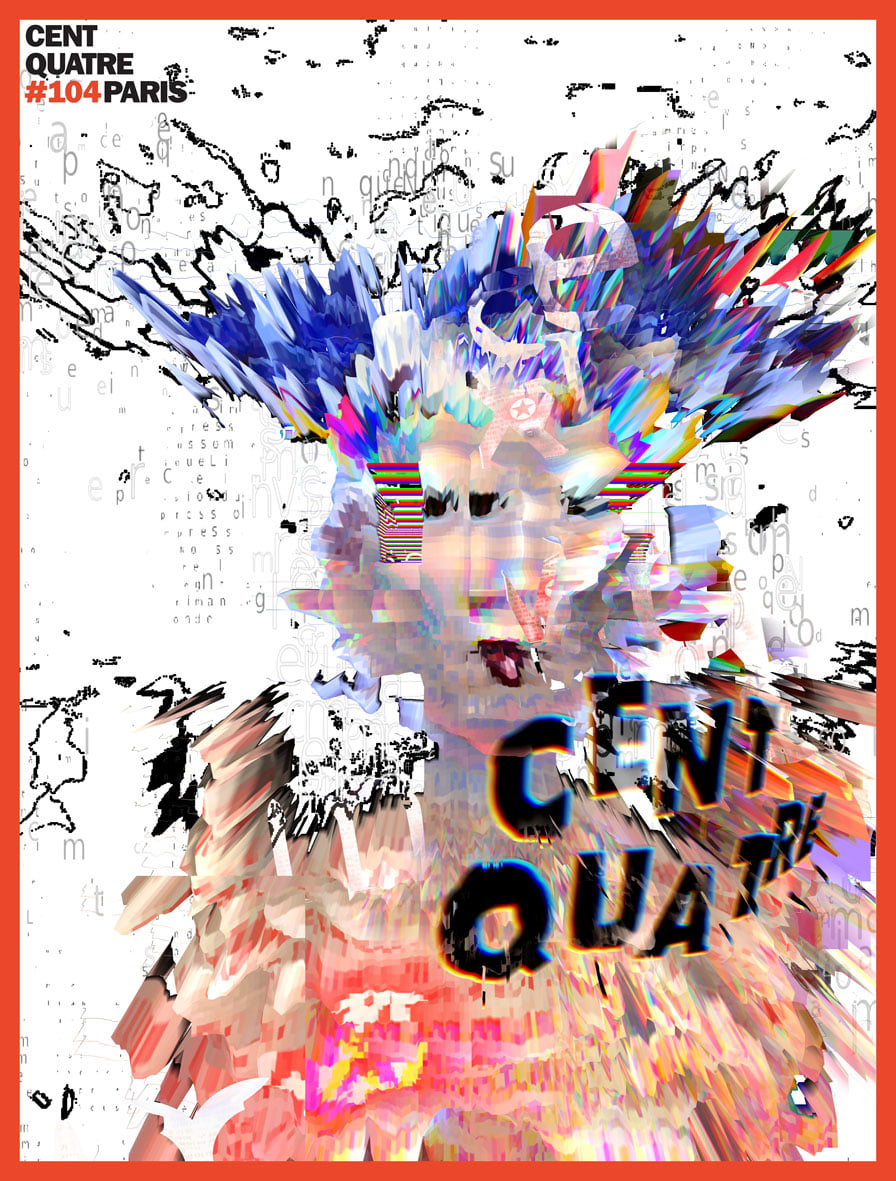 Installation with Beb_Deum — NEMO Biennale
2019–2020 — Collaborative installation for the NEMO biennial at Le 104, Paris.
Installation with Beb_Deum — NEMO Biennale
2019–2020 — Collaborative installation for the NEMO biennial at Le 104, Paris.
-
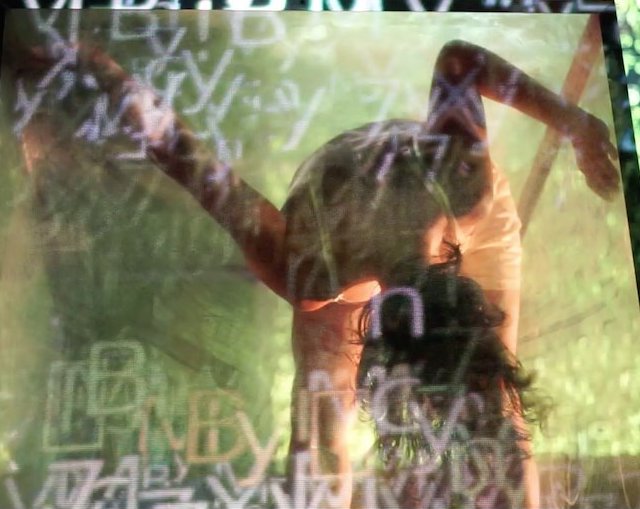 Urbain sensible
2019 — Audio-visual performance with Noémie Fargier on urban sensibility.
Urbain sensible
2019 — Audio-visual performance with Noémie Fargier on urban sensibility.
-
 Fractal Identity
2019 — Interactive installation contextually questioning the constitution of the subject.
Fractal Identity
2019 — Interactive installation contextually questioning the constitution of the subject.
-
 Black Hole in the Language
2019 — Interactive participatory installation on the web and forgetting.
Black Hole in the Language
2019 — Interactive participatory installation on the web and forgetting.
-
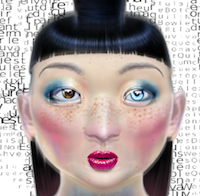 IADOLL
2018 — Conversational AI created with the illustrator Beb-Deum.
IADOLL
2018 — Conversational AI created with the illustrator Beb-Deum.
-
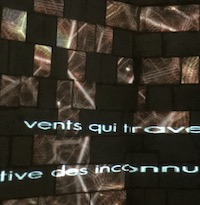 Horizon(s)
2018 — Generative 270° mapping for an exhibition on graffiti, La Rochelle.
Horizon(s)
2018 — Generative 270° mapping for an exhibition on graffiti, La Rochelle.
-
 kOsmOnOise
2018 — Audio-visual performance with Maud Brethenoux. Poetic-shamanic noise.
kOsmOnOise
2018 — Audio-visual performance with Maud Brethenoux. Poetic-shamanic noise.
-
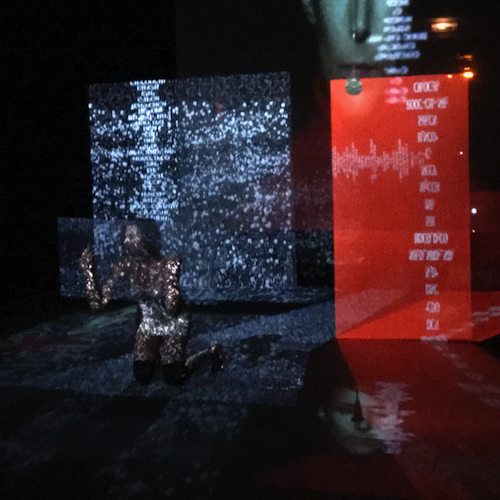 alpha_lab
2016–2018 — Choreographic creation + real-time mapping. From atom to cosmos.
alpha_lab
2016–2018 — Choreographic creation + real-time mapping. From atom to cosmos.
-
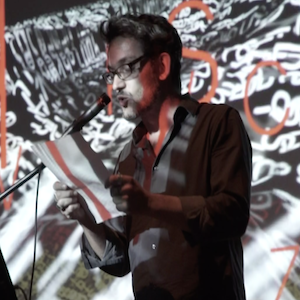 Poétique de la méchanceté
2017–2018 — Interactive digital poetry on a post-human landscape after the destruction of humanity.
Poétique de la méchanceté
2017–2018 — Interactive digital poetry on a post-human landscape after the destruction of humanity.
-
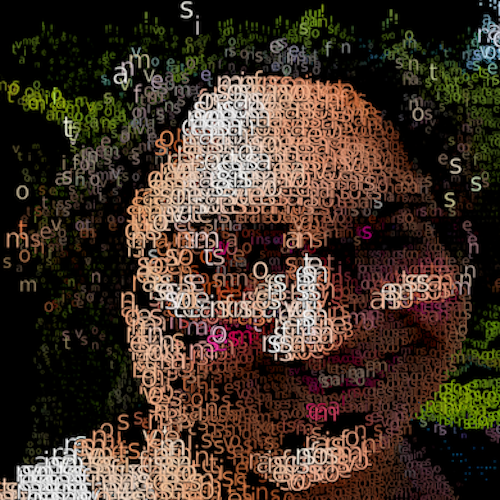 Saint Symphorien Faces
2017–2018 — Created with Rémi Checchetto during the Chalet Mauriac residency.
Saint Symphorien Faces
2017–2018 — Created with Rémi Checchetto during the Chalet Mauriac residency.
-
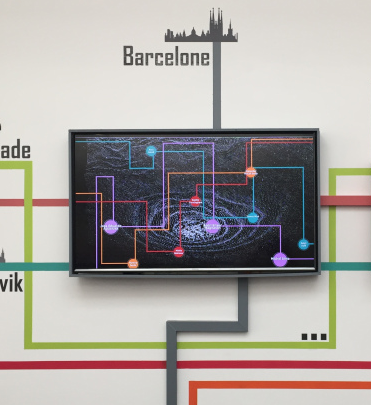 Traversées géopolitiques
2017 — Installation for the 11th UNESCO Creative Cities meeting, Enghien-les-bains.
Traversées géopolitiques
2017 — Installation for the 11th UNESCO Creative Cities meeting, Enghien-les-bains.
-
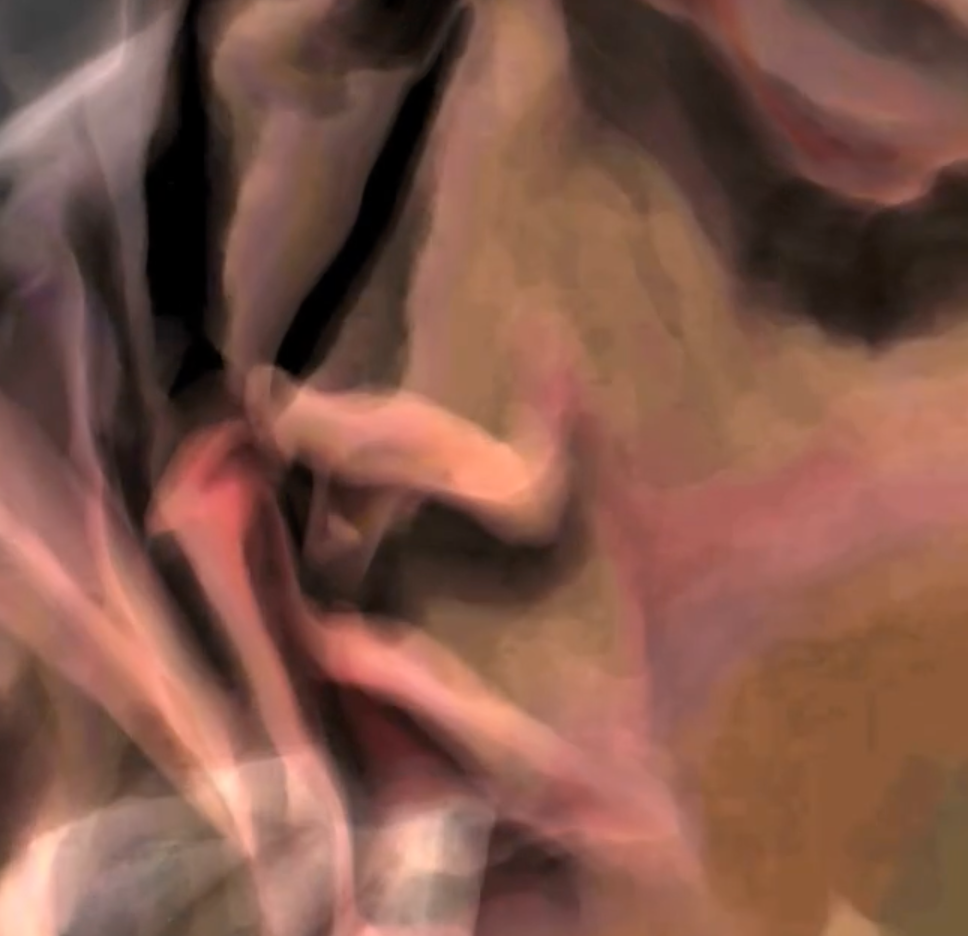 Intensity of Kiss
2017 — From a chromatic temporal anamorphosis, 32 cinema kisses chain together.
Intensity of Kiss
2017 — From a chromatic temporal anamorphosis, 32 cinema kisses chain together.
-
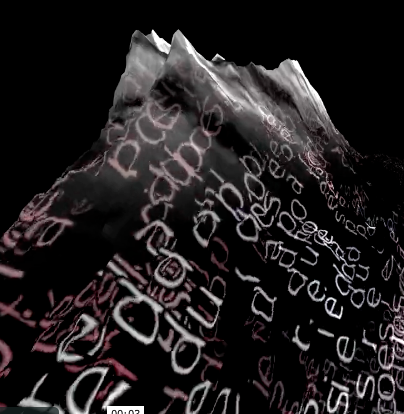 Paysage de la catastrophe
2016–2018 — Generative installation: landscapes from real-time press analysis on the destruction of humanity.
Paysage de la catastrophe
2016–2018 — Generative installation: landscapes from real-time press analysis on the destruction of humanity.
-
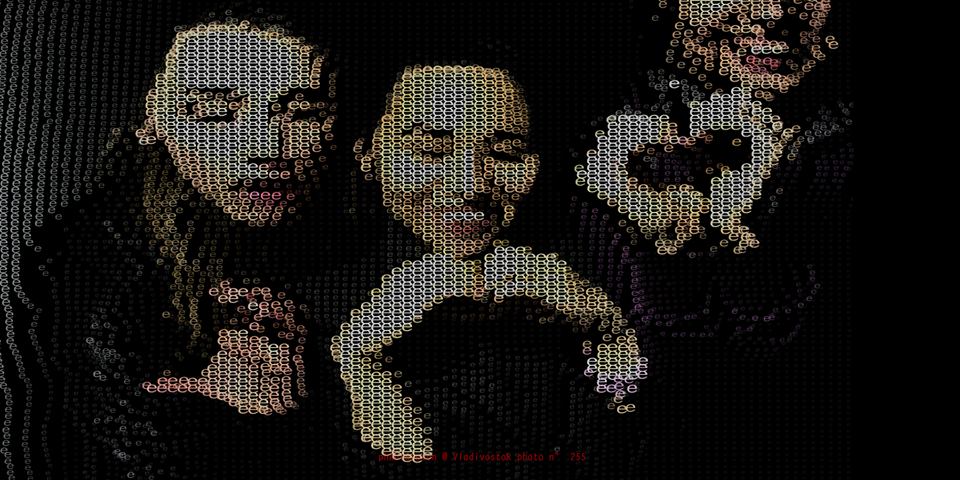 phAUTOmaton
2013–2018 — Participants create their portrait in real time from their own words.
phAUTOmaton
2013–2018 — Participants create their portrait in real time from their own words.
-
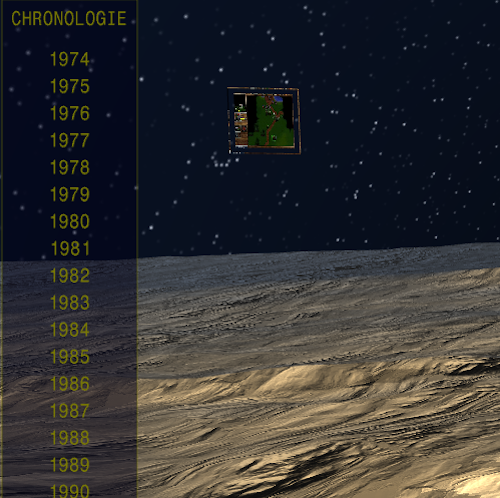 Borne interactive — Festival Acces-s 16
2016 — Interactive kiosk on video games + giant aesthetic-cognitive schema.
Borne interactive — Festival Acces-s 16
2016 — Interactive kiosk on video games + giant aesthetic-cognitive schema.
-
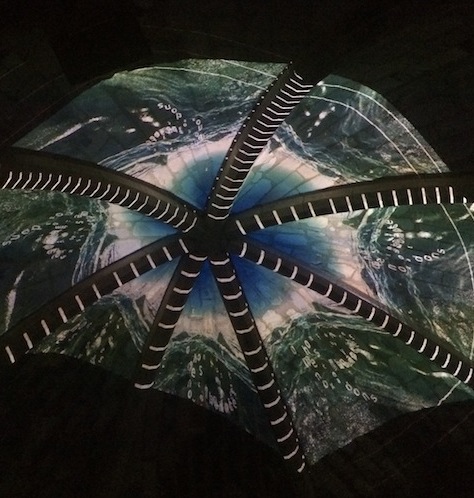 Renversement
2016 — Architectural mapping in the Tour de La Lanterne, La Rochelle, Festival Zéro1.
Renversement
2016 — Architectural mapping in the Tour de La Lanterne, La Rochelle, Festival Zéro1.
-
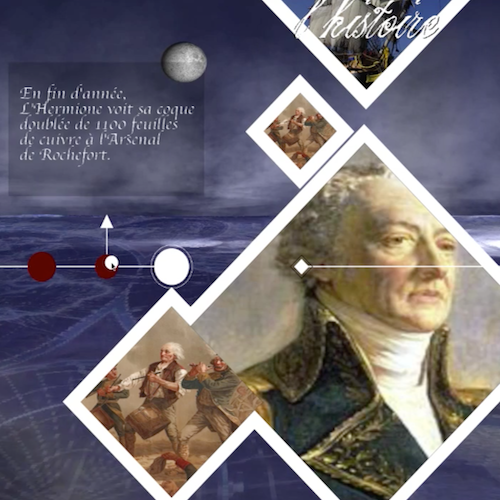 Borne interactive Hermione
2015 — Interactive kiosk following Lafayette's ship route from France to the USA.
Borne interactive Hermione
2015 — Interactive kiosk following Lafayette's ship route from France to the USA.
-
 Shape_of_memory
2014–2016 — Interactive participatory installation on memory, with Arnaud Courcelle.
Shape_of_memory
2014–2016 — Interactive participatory installation on memory, with Arnaud Courcelle.
-
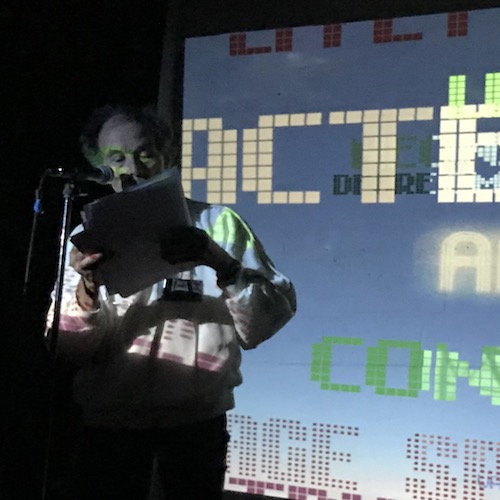 Poésie en Pure Data
2013–2018 — Pure Data patch for Jacques Donguy's digital poetry performance.
Poésie en Pure Data
2013–2018 — Pure Data patch for Jacques Donguy's digital poetry performance.
-
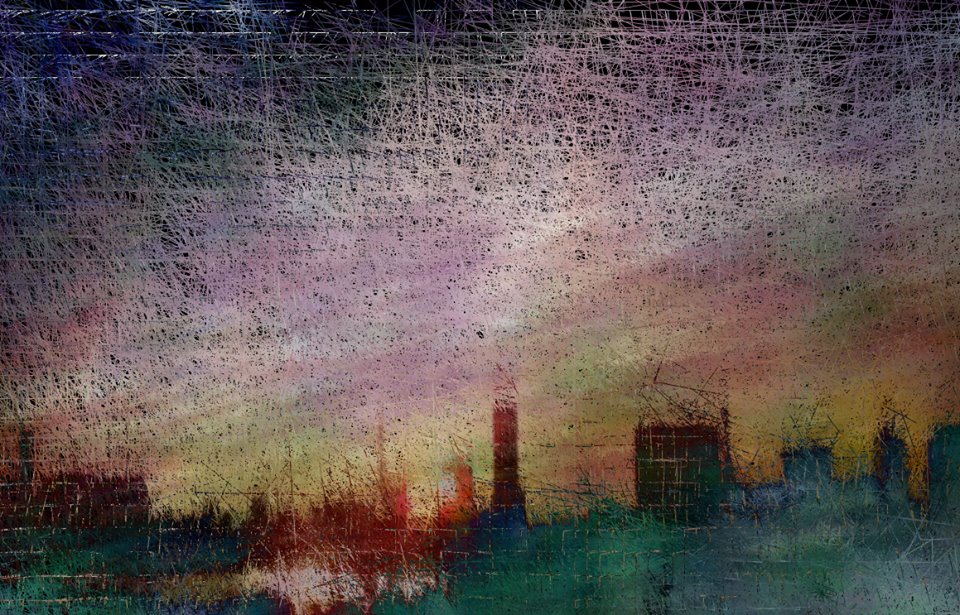 Translation v.3 + Installation
2013–2015 — 2014 version of Translation + installation.
Translation v.3 + Installation
2013–2015 — 2014 version of Translation + installation.
-
 L'argent
2013 — Anne-Théron from Christophe Tarkos's text. Video mapping creation and programming.
L'argent
2013 — Anne-Théron from Christophe Tarkos's text. Video mapping creation and programming.
-
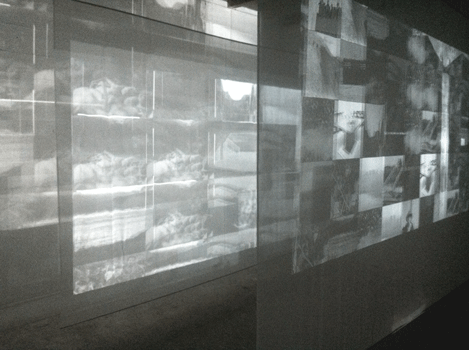 Scenic Railway
2013 — Renaud Chambon's interactive work with Leap Motion. Multimedia conception and programming.
Scenic Railway
2013 — Renaud Chambon's interactive work with Leap Motion. Multimedia conception and programming.
-
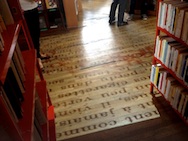 M-ondes
2013 — One-year installation created for the Angoulême library.
M-ondes
2013 — One-year installation created for the Angoulême library.
-
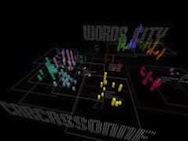 Words-City
2012–2013 — Interactive participatory installation built from smartphone messages.
Words-City
2012–2013 — Interactive participatory installation built from smartphone messages.
-
 Translation
2012–2013 — Live audio/video performance.
Translation
2012–2013 — Live audio/video performance.
-
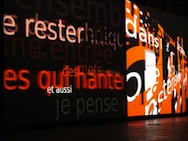 Contact
2011–2013 — Digital performance: augmented chat between a man and a woman.
Contact
2011–2013 — Digital performance: augmented chat between a man and a woman.
-
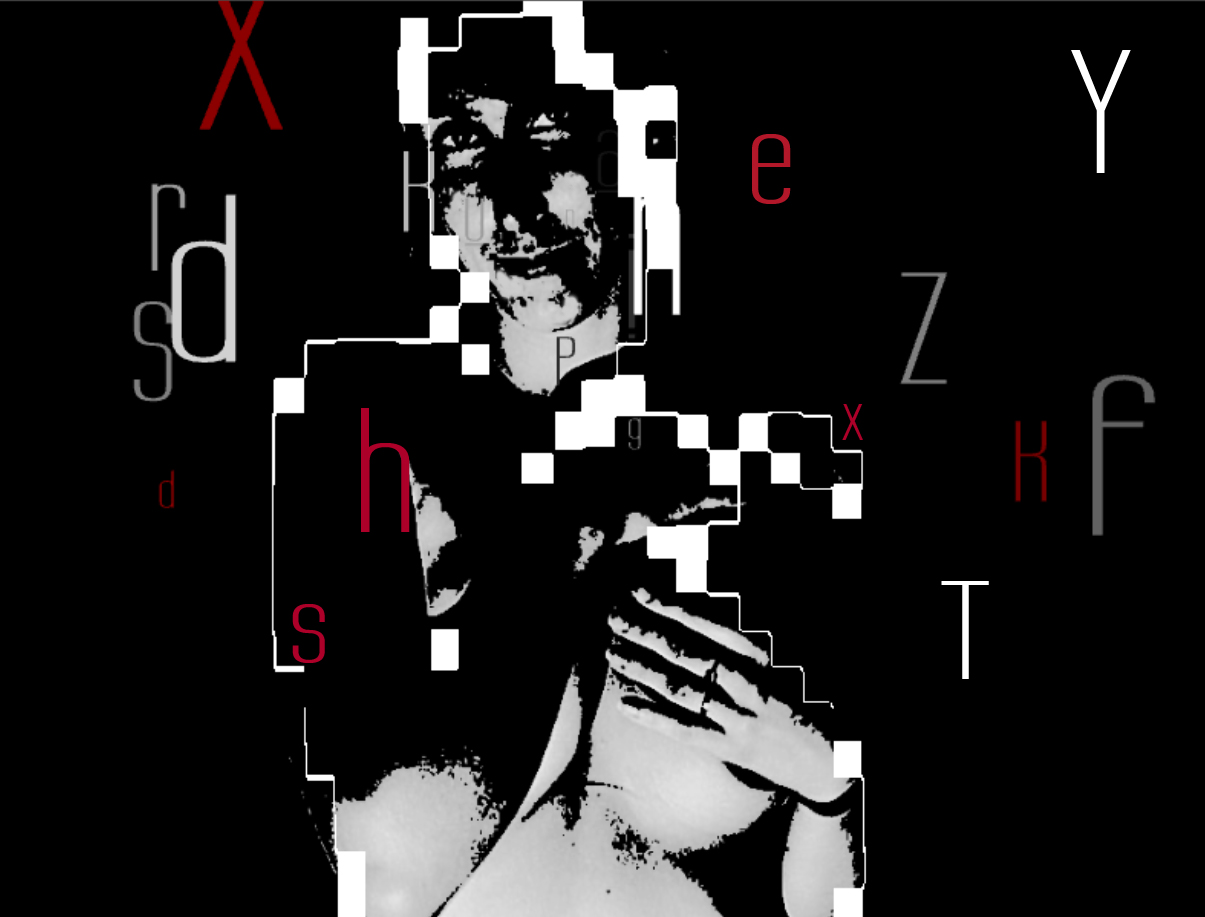 Le fantôme grandit sous la main qui écrit
2011–2013 — Installation on the gap between the addresser's desire and what is addressed.
Le fantôme grandit sous la main qui écrit
2011–2013 — Installation on the gap between the addresser's desire and what is addressed.
-
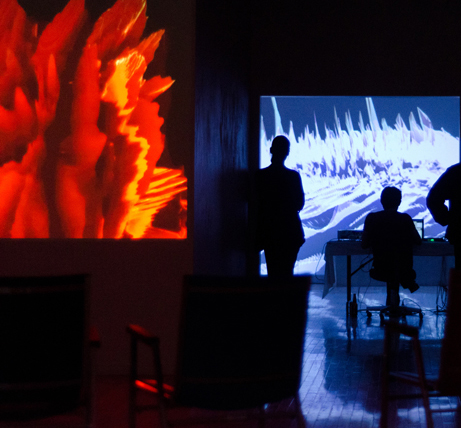 L'Odyssée (duo)
2010–2012 — Live audio/video duo with Jean Voguet (music).
L'Odyssée (duo)
2010–2012 — Live audio/video duo with Jean Voguet (music).
-
 TEKHE
2012 — Live audio-video work with Jean Voguet.
TEKHE
2012 — Live audio-video work with Jean Voguet.
-
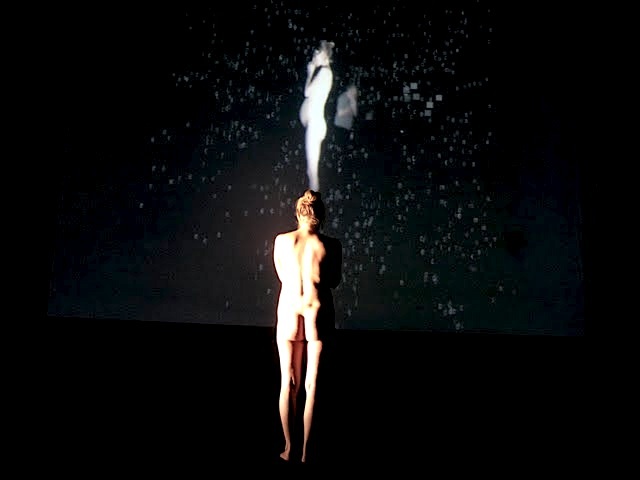 Conception (trio)
2010 — Multimedia (P. Boisnard), poetry (Julien Blaine), voice (Hortense Gauthier).
Conception (trio)
2010 — Multimedia (P. Boisnard), poetry (Julien Blaine), voice (Hortense Gauthier).
-
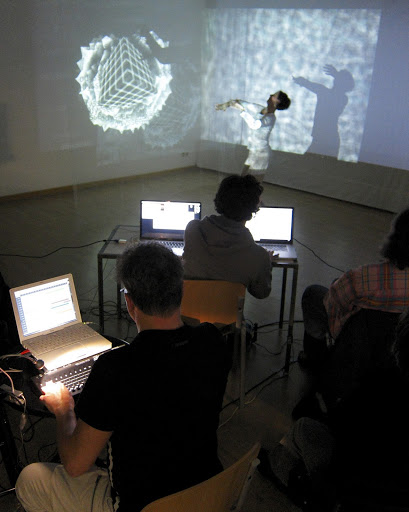 L'Odyssée (trio)
2010–2012 — Dance (Estelle de Montalembert), sound (Jean Voguet), live video (P. Boisnard).
L'Odyssée (trio)
2010–2012 — Dance (Estelle de Montalembert), sound (Jean Voguet), live video (P. Boisnard).
-
 Zone de déportation commerciale
2011 — Installation/performance at the Infr'action festival in Sète.
Zone de déportation commerciale
2011 — Installation/performance at the Infr'action festival in Sète.
-
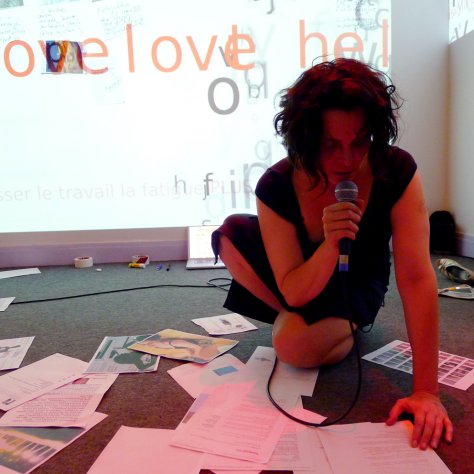 Identifiant Lucille Calmel
2011 — Stage installation by Lucille Calmel for Open Paris-Villette / Scènes virtuelles.
Identifiant Lucille Calmel
2011 — Stage installation by Lucille Calmel for Open Paris-Villette / Scènes virtuelles.
-
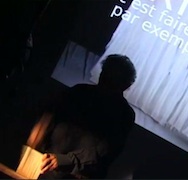 Manutensions / écritures en extension
2011 — Performative installation by Giney Ayme. Multimedia retreatment device.
Manutensions / écritures en extension
2011 — Performative installation by Giney Ayme. Multimedia retreatment device.
-
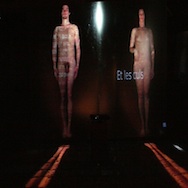 Désirs programmables
2011 — Interactive installation by Gérard Chauvin. Multimedia design and programming.
Désirs programmables
2011 — Interactive installation by Gérard Chauvin. Multimedia design and programming.
-
 SICK
2011 — Installation with Lucille Calmel — Mois de la photographie, Casino du Luxembourg.
SICK
2011 — Installation with Lucille Calmel — Mois de la photographie, Casino du Luxembourg.
-
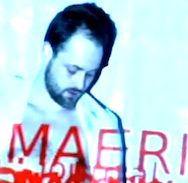 Auborddugouffre
2009–2010 — Stage performance by Lucille Calmel. Interactive multimedia device.
Auborddugouffre
2009–2010 — Stage performance by Lucille Calmel. Interactive multimedia device.
-
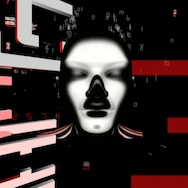 EPT
2009–2010 — Live cinema: history of writing from aleph to @.
EPT
2009–2010 — Live cinema: history of writing from aleph to @.
-
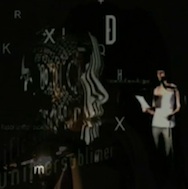 HLEINE MASCHINE
2008–2009 — Digital performance by hp process.
HLEINE MASCHINE
2008–2009 — Digital performance by hp process.
Practice & Research
Philippe Boisnard is an artist, writer, and researcher working at the intersection of artificial intelligence, digital poetics, and computational aesthetics. His practice explores the latent structures embedded within generative models — the unconscious patterns, cultural biases, and perceptual habits that machines inherit from their training data.
His current work focuses on using segmentation models (SAM) and vision-language models (CLIP) as instruments of critical analysis, treating AI not as a creative tool but as a mirror that reveals the hidden architectures of visual culture. By walking through the latent spaces of generative and analytical models, his projects make visible what these systems have learned to see — and what they systematically fail to perceive.
His approach draws on a lineage that includes Lev Manovich's Cultural Analytics, extending computational art analysis from physical measurement to semantic interpretation. Where earlier methods measured brightness and saturation, Boisnard's work asks whether a painting is sacred or profane, ordered or chaotic — questions that only became computationally tractable with the emergence of multimodal AI models.